

News and Trends
Mobile App Flame Control, WANLIN-620, Ahmedabad
TL;DR: Wanlin Trains Ahmedabad Partner Crews on Flame Detector Siting and Aiming
Wanlin trains partner crews on flame detector siting, aiming and commissioning for Ahmedabad and India warehouse and logistics operators, battery energy storage and EV charging integrators, refinery, petrochemical and chemical plant owners, fuel depot and loading rack operators, power and renewable asset owners, tunnel and parking operators, marine and offshore operators, data centre and telecom operators, heritage and public estate managers, fire and safety distributors, industrial and electrical wholesalers, EPC contractors, system integrators, importers, trading companies and sourcing agents. A fire in a large volume is not a smoke problem, it is a time problem: by the time a smoke plume has travelled up to a ceiling device in a high bay, a rack aisle or a container row, the incident has already moved. The Wanlin flame detection line answers that by looking for the flame itself - ultraviolet and infrared radiation on the emission bands, flicker frequency and flame signature - rather than waiting for smoke to arrive. WANLIN-620 is supplied as a UV/IR point detector, an IR3 triple infrared detector and an AI video flame recognition camera, with a declared response time and a declared detection distance measured on reference fire sources, false-alarm rejection against welding arcs, sunlight, halogen light and hot surfaces, an automatic optical path self-test that reports a fouled window instead of going quietly blind, Ex db and Ex ia hazardous-area enclosures with the concept, gas group and temperature class on the label, IP66 and IP67 ingress, fire and fault relays, a 4-20 mA loop, RS485 Modbus RTU and BACnet and MQTT paths into the building management system, the SCADA layer and the cloud, and a suppression release output to a deluge or gas valve. Where a site also runs smoke, heat, gas or water telemetry, the wider WANLIN device family joins the same host and the same event log. Every shipment leaves with EN 54-10, FM 3260, ISO 7240-10, ATEX and IECEx documentation, SIL 2 and SIL 3 tracks referenced to IEC 61508 and IEC 61511, CE, RoHS, REACH and FCC files, calibration records per lot and a commissioning record from the Ahmedabad test floor. OEM/ODM with private label, factory-direct export supply for Ahmedabad and India, and an open distributor, integrator and agent programme for 2026-2027.
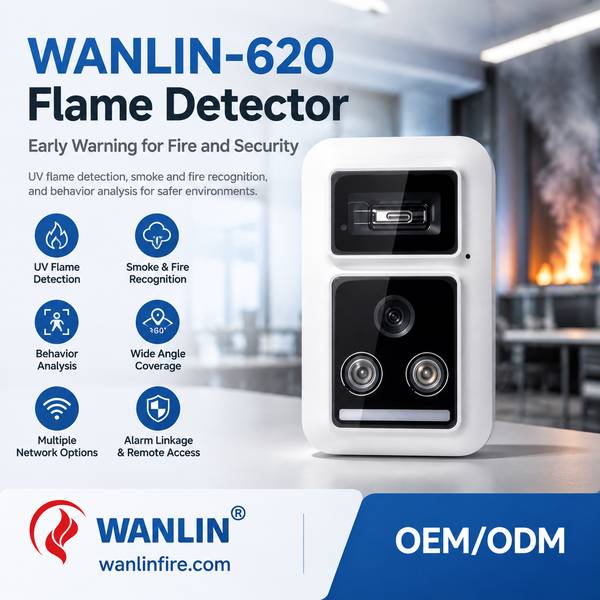
Featured WANLIN device this report: WANLIN-620 AI Video Flame Recognition Camera - AI video flame recognition camera with Wi-Fi and Ethernet uplink for warehouse interiors, battery energy storage halls, EV charging halls, tunnels and enclosed parking decks; sensing and method Visible-light and thermal imaging channels feeding a convolutional flame and smoke model that runs on the edge processor in the camera, classifying flame spectral signature, shape and flicker behaviour in the frame rather than at a single point; output and signalling Fire relay and fault relay, RTSP and ONVIF video stream, MQTT event topic with the bounding box and the confidence value, and a 4-20 mA output on request; connectivity Wi-Fi and Ethernet with a 4G Cat-1 backhaul option; MQTT, RTSP, ONVIF and Modbus TCP into the BMS, the SCADA layer or the video management system; mounting Wall or ceiling bracket with a three-axis adjustment, conduit or PoE entry, integral sun shield and a hydrophobic window coating; ingress protection IP66; enclosure Aluminium alloy housing with a heated window, an integral sun shield and a powder-coated finish; 316 stainless steel bracket for coastal and tunnel installations; indication Status LED plus a live and recorded video stream with an on-screen event overlay, a browser commissioning interface and a local reset control; extra features Edge inference with no cloud dependency, zone-of-interest masking to exclude a furnace or a welding bay, clip recording around each event, automatic lens contamination detection, over-the-air model and firmware update, event log with a still frame per alarm.; warranty and after-sales 3-year limited warranty on the camera body, 30-day DOA replacement, five-year spare-parts window with a documented obsolescence path; in the box Camera with three-axis bracket, PoE injector or power lead, sun shield, commissioning card, mounting template and the certificate folder for the destination market. Full component data sheet below.
Published by Wanlin Manufacturing Group (Wanlin Brand) | Last updated: September 23, 2026 | Expertise: 15+ years fire detection, gas detection, instrumentation and building safety device manufacturing and export
Dispatch note for Ahmedabad: India-bound consignments leave Shenzhen via Mumbai (JNPT / Nhava Sheva) on the Arabian Sea, Mundra on the Gulf of Kutch, Chennai on the East Coast and Kolkata on the Bay of Bengal, with feeder trucking and rail into Delhi, Bengaluru, Hyderabad, Ahmedabad, Pune, Surat and Kochi. Detectors, brackets, sun shields, glands, commissioning tools, spares and the country documentation folder are consolidated at the factory before sailing; typical door-to-door lead time for India runs 22-28 days after the batch clears pre-shipment inspection, with sample units shipped by air inside 10-15 days for partners who want to test one bay before committing to a programme.
About Wanlin: Chinese Flame Detector Manufacturer and Export Supplier
Wanlin is the fire protection and industrial safety products brand of Wanlin Manufacturing Group, a 15-year Chinese manufacturer headquartered in Shenzhen, China. The brand builds the flame detection line - UV, IR, UV/IR, IR3 and multi-spectrum point detectors, AI video flame recognition cameras, the optics and decision logic behind them, the hazardous-area enclosures, the bracket and aiming hardware, the wired and wireless uplinks and the cloud fleet layer - for warehouse and logistics operators, battery energy storage and EV charging integrators, refinery, petrochemical and chemical plant owners, fuel depot and loading rack operators, power and renewable asset owners, tunnel and parking operators, marine and offshore operators, data centre and telecom operators, heritage and public estate managers, fire and safety distributors, industrial and electrical wholesalers, EPC contractors and system integrators across Ahmedabad, India and more than 60 export markets.
Wanlin operates a genuine source factory with in-house injection molding, SMT PCB assembly, optical assembly and alignment stations, a live flame test range with reference liquid and gas fire sources and timed response measurement, an optical attenuation and contamination bench, environmental chambers for humidity, temperature, thermal shock and salt-spray cycling, ingress test rigs, radio link test beds and a live functional test line. Our factory builds the complete flame detection line and the WANLIN device family around it - all configurations supported by CE marking with the EMC and radio equipment directives where a radio link is fitted, RoHS and REACH material files, FCC certification for the US with FCC Part 15 on the radio options, EN 54-10 for point flame detectors with the type-test report covering response time, detection distance, field of view and false-alarm rejection, EN 54-5 for the heat channel and EN 54-7 for the smoke channel where the same submission pack carries them, FM 3260 documentation for radiant energy-sensing fire detectors on the North American route, UL 268 for the smoke channel and UL 521 for the heat channel in the same folder, ISO 7240-10 for point flame detectors, ATEX documentation under the European equipment directive and IECEx certification for the international hazardous-area route with the Ex db, Ex eb and Ex ia concepts and the gas group and temperature class stated per model, SIL 2 and SIL 3 capability documentation referenced to IEC 61508 and IEC 61511 for process sites, NFPA 72 for the fire alarm and signaling installation, NFPA 15 for water spray and deluge interfaces, NFPA 30 and NFPA 70 for flammable liquid and hazardous location wiring practice, BS 5839 for British system practice, EAC and GOST for the Eurasian customs union, KC for Korea, PSE for Japan, CCCF for the Chinese domestic fire market, SASO and SABER support for Saudi Arabia, TISI for Thailand, SNI for Indonesia, SIRIM for Malaysia, DTI-BPS and BFP for the Philippines, BIS for India, SABS for South Africa, NOM for Mexico, INMETRO for Brazil, NIST-traceable calibration records per production lot against reference flame sources and optical attenuation targets, ISO 9001 and ISO 14001 factory systems, OEM/ODM and private label, custom colour and logo programs, private-label packaging, multi-language manuals (English / Arabic / Russian / Spanish / French / Portuguese / Indonesian / Urdu / Hindi / Vietnamese / Thai), and spares and consumables programs sized to each partner's annual project volume.
Inside the Wanlin Flame Detection Stack: Optics, Decision, Output, Hazard and Evidence
A flame detector is bought for one reason and rejected for another: it is bought for speed and it is rejected for nuisance alarms. Everything in the stack exists to keep both of those true at the same time - the optics decide what the device can see, the decision logic decides what it will ignore, the enclosure decides where it may be installed, and the output decides whether anything happens when it fires. The table below is the stack in the order a Ahmedabad buyer should read it.
| Layer | What it decides | Field data from the Ahmedabad programme |
|---|---|---|
| Optical channels | Ultraviolet at 185-260 nm for fast clean fires, infrared on the 4.3 um CO2 emission band for hydrocarbon fires, and reference bands on the IR3 and multi-spectrum units that separate a flame from a hot body | Reference liquid and gas fire sources detected inside the declared response time at every distance step out to 40 m; no miss at the maximum declared distance |
| Decision logic | Flicker frequency, flame signature, band ratio and multi-criteria fusion - the stage that separates a flame from a welding arc, a sunrise, a halogen lamp or a hot exhaust | Welding arc, halogen floodlight and hot surfaces produced no fire decision at the declared immunity distance; sunlight produced no event on any run |
| Response and coverage | Declared response time and declared detection distance measured on a reference fire source, together with the horizontal and vertical field of view the cone is drawn from | 10 s to the fire relay at the declared distance; the horizontal and vertical cone matched the declared 90-degree field of view when walked out on the floor |
| Enclosure and hazardous area | Ex db flameproof or Ex ia intrinsically safe concept, gas group and temperature class, the gland and conduit entries and the ingress rating - the licence to install in a zoned area | Flameproof joints, window assembly and glands held at the declared rating; ingress protection held at IP66 after exposure; the concept, gas group and temperature class remained legible on the label |
| Window and self-test | An automatic optical path self-test that reports a degraded or blocked window as a maintenance state rather than a silent loss of detection | Degraded path raised a maintenance state before performance left the declared band; a blocked path raised a fault at the device, the relay and the platform |
| Output and action | Fire relay, fault relay, 4-20 mA loop, RS485 Modbus RTU, BACnet and MQTT, and a suppression release channel into a deluge or gas valve | Relays operated within the declared switching rating on every run; the release channel drove the valve interface inside the declared time |
| Uplink and evidence | 4G, NB-IoT, LoRaWAN, Wi-Fi and Ethernet paths carrying the event, the device identity, a timestamp and, on the video units, a still frame and a clip | Event reached the cloud account, the app and the SMS path within the declared latency on every run; event history matched the device log line for line |
| WANLIN device layer | Where the site also runs smoke, heat, gas or water telemetry, the WANLIN family joins the same host and the same account - one fleet, one log, one spares list | WANLIN-620 AI Video Flame Recognition Camera commissioned on the Ahmedabad programme with the same host, the same event log and the same spares list as the rest of the package |
Where the boundary sits: a flame detector, a smoke detector and a heat detector are three different answers to three different questions, and they are declared to EN 54-10, EN 54-7 and EN 54-5 respectively. The flame channel is the fast one - it sees radiation, so it does not wait for a plume to travel - and it is the one you specify where the volume is large, the fire is fast and there is something worth shutting down within seconds. Wanlin builds all three channels and specifies them per risk, with the flame channel covering the volume, the smoke channel covering the enclosed spaces and the heat channel covering the plant areas where smoke is normal and radiation is not.
WANLIN-620 Technical Specifications
| Parameter | WANLIN-620 AI Video Flame Recognition Camera | Typical Import Unit |
|---|---|---|
| Role in the Flame Programme | AI video flame recognition camera with Wi-Fi and Ethernet uplink for warehouse interiors, battery energy storage halls, EV charging halls, tunnels and enclosed parking decks | Single device with no declared detection distance and no false-alarm immunity list |
| Sensing Element / Detection Method | Visible-light and thermal imaging channels feeding a convolutional flame and smoke model that runs on the edge processor in the camera, classifying flame spectral signature, shape and flicker behaviour in the frame rather than at a single point | Uncalibrated element, no method documentation |
| Output and Signalling | Fire relay and fault relay, RTSP and ONVIF video stream, MQTT event topic with the bounding box and the confidence value, and a 4-20 mA output on request | Basic relay only, no loop, no protocol, no release output |
| Connectivity and Protocol | Wi-Fi and Ethernet with a 4G Cat-1 backhaul option; MQTT, RTSP, ONVIF and Modbus TCP into the BMS, the SCADA layer or the video management system | No protocol, no telemetry, no cloud path |
| Mounting and Installation | Wall or ceiling bracket with a three-axis adjustment, conduit or PoE entry, integral sun shield and a hydrophobic window coating | Proprietary fitting, no aiming aid, extra adaptors on site |
| Ingress Protection | IP66 | Unrated enclosure, dry indoor areas only |
| Enclosure and Material | Aluminium alloy housing with a heated window, an integral sun shield and a powder-coated finish; 316 stainless steel bracket for coastal and tunnel installations | Recycled plastic, unknown flame rating, no hazardous-area concept |
| Indication and Interface | Status LED plus a live and recorded video stream with an on-screen event overlay, a browser commissioning interface and a local reset control | Single LED, no test or reset control |
| Imaging and Edge Subsystem | 1/3-inch CMOS visible sensor at 2560 x 1440, fixed 3 mm lens at F1.6, UV sensor with a >=90-degree field of view and a 15 m detection distance with adjustable sensitivity, 1.2 GHz single-core processor with a 0.5 TOPS NPU running the flame and smoke model on the edge, main stream 2560 x 1440 / 1920 x 1080 / 1280 x 720 and sub stream 704 x 576 / 960 x 544 / 640 x 360 / 320 x 184, H.265 and H.264 BP/MP/HP encoding at 30 kbps - 16 Mbps with CBR/VBR, audio in G.711A / G.711U / AAC, image settings for contrast / sharpness / brightness / saturation. | No imaging subsystem |
| Extra Features | Edge inference with no cloud dependency, zone-of-interest masking to exclude a furnace or a welding bay, clip recording around each event, automatic lens contamination detection, over-the-air model and firmware update, event log with a still frame per alarm. | None |
| Certification and Compliance | CE marking with the EMC and radio equipment directives where a radio link is fitted, RoHS and REACH material files, FCC certification for the US with FCC Part 15 on the radio options, EN 54-10 for point flame detectors with the type-test report covering response time, detection distance, field of view and false-alarm rejection, EN 54-5 for the heat channel and EN 54-7 for the smoke channel where the same submission pack carries them, FM 3260 documentation for radiant energy-sensing fire detectors on the North American route, UL 268 for the smoke channel and UL 521 for the heat channel in the same folder, ISO 7240-10 for point flame detectors, ATEX documentation under the European equipment directive and IECEx certification for the international hazardous-area route with the Ex db, Ex eb and Ex ia concepts and the gas group and temperature class stated per model, SIL 2 and SIL 3 capability documentation referenced to IEC 61508 and IEC 61511 for process sites, NFPA 72 for the fire alarm and signaling installation, NFPA 15 for water spray and deluge interfaces, NFPA 30 and NFPA 70 for flammable liquid and hazardous location wiring practice, BS 5839 for British system practice, EAC and GOST for the Eurasian customs union, KC for Korea, PSE for Japan, CCCF for the Chinese domestic fire market, SASO and SABER support for Saudi Arabia, TISI for Thailand, SNI for Indonesia, SIRIM for Malaysia, DTI-BPS and BFP for the Philippines, BIS for India, SABS for South Africa, NOM for Mexico, INMETRO for Brazil, NIST-traceable calibration records per production lot against reference flame sources and optical attenuation targets, ISO 9001 and ISO 14001 factory systems, OEM/ODM and private label | Incomplete or missing |
| Warranty and After-Sales | 3-year limited warranty on the camera body, 30-day DOA replacement, five-year spare-parts window with a documented obsolescence path | No spares path, no documentation support |
| Ships in the Box | Camera with three-axis bracket, PoE injector or power lead, sun shield, commissioning card, mounting template and the certificate folder for the destination market | Unit only, no bracket, no fixings or documentation |
Supply terms: Factory-direct pricing | OEM/ODM and private label | Cartons packed by bay, by unit or by phase | EN 54-10, FM 3260, ISO 7240-10, ATEX, IECEx, SIL 2 and SIL 3, CE, RoHS, REACH, FCC and UKCA documentation with every order | Custom colours, logo printing and carton branding | Spares, window service kits and bracket programs sized to your annual volume | Platform accounts and API access provisioned before shipment | Sea freight via Mumbai (JNPT / Nhava Sheva) on the Arabian Sea, Mundra on the Gulf of Kutch, Chennai on the East Coast and Kolkata on the Bay of Bengal, with feeder trucking and rail into Delhi, Bengaluru, Hyderabad, Ahmedabad, Pune, Surat and Kochi, plus air options for sample units and urgent top-ups | Warranty and after-sales spare parts program.
Featured programme profile this report - High-Bay Warehouse and Logistics Centre Profile (Wide Cone, High Rack): the configuration most Ahmedabad warehouse, distribution and third-party logistics operators start with: point UV/IR or IR3 detectors mounted on the structure and aimed down the rack aisles, with a declared cone coverage per unit and an overlap drawn at the ends of each aisle rather than a grid on a drawing A warehouse is a volume, not a floor. The detector has to see past the top of the rack to the far end of the aisle, which is why the schedule is drawn as cones in section - height, tilt and overlap - and not as circles on a plan.
Flame Detector, Smoke Detector, Heat Detector, Thermal Camera: Where the Boundary Sits
This is the distinction the Ahmedabad export desk spends the most time on, and getting it wrong is how a site ends up with a compliant drawing and a fire nobody saw in time. The four technologies look at four different things, they are declared to four different standards, and they fail in four different ways. The table below is how we draw the line before a coverage drawing is issued.
| Question | Flame detector (EN 54-10) | Smoke detector (EN 54-7) | Heat detector (EN 54-5) | Thermal imaging camera |
|---|---|---|---|---|
| What it detects | Radiation from the flame: ultraviolet and infrared energy on the emission bands, plus the flicker signature | Visible and invisible combustion particles that have travelled to the device | Temperature or rate of temperature rise at the device | Surface temperature across a scene, with a flame and smoke model on the analytic units |
| Why it exists | Speed in a large volume: see the flame at distance, before a plume forms or travels | Life safety in enclosed spaces with a ceiling and a circulation route | Plant and industrial areas where smoke or dust is normal but a temperature excursion is not | Visual verification, hot-spot monitoring and post-event investigation |
| Response model | Declared response time and detection distance on a reference fire source, within a declared field of view | Threshold on the chamber signal once smoke enters it | Fixed temperature or rate-of-rise threshold | Model or threshold on the scene, with an operator or an analytic decision |
| Where it is fitted | Aimed at the risk from a wall, a column or the structure, with the cone walked out and overlaps drawn | On the ceiling or high on the wall in the protected space | On the ceiling or over the plant item | Overlooking the risk, usually with a wider scene than a point detector |
| What it is weak at | It needs line of sight - racking, plant and structure cast shadows that have to be drawn and re-aimed | Slow in a large volume; a high bay, an open yard or a windy covered area dilutes the plume before it arrives | Slow by definition: it waits for the heat to reach it | It reports a temperature, not a fire, unless it carries a flame and smoke model with a declared immunity list |
| What replaces what | Nothing replaces anything. A fast flame in a large volume needs the flame channel; an enclosed occupied space needs the smoke channel; a dusty plant area needs the heat channel; and an operator who has to see what is happening needs the video channel. A serious specification uses the flame channel for speed, the smoke channel for the enclosed spaces, the heat channel for the plant areas and the video channel for verification - and lands all four on one host so there is one event log rather than four. | |||
In one line: the smoke detector waits for smoke to arrive, the heat detector waits for heat to arrive, and the flame detector looks at the fire the moment there is one. Wanlin builds all four and specifies per risk, which is why the coverage drawing is issued before the quotation rather than after the order.
Competitive Comparison: Wanlin vs Other Flame Detection Sources
| Supplier type | Advantages | Disadvantages |
|---|---|---|
| Wanlin (Factory Direct) | 15-year manufacturer; the optics, the enclosure, the decision firmware, the radio and the flame test range sit in one factory, so the response time, the immunity list and the hazardous-area file stay consistent across lots; UV, IR, UV/IR, IR3, multi-spectrum and AI video configurations from one catalogue; CE, RoHS, REACH, FCC, UKCA, EN 54-10, FM 3260, ISO 7240-10, ATEX and IECEx documentation with every shipment; SIL 2 and SIL 3 documentation tracks referenced to IEC 61508 and IEC 61511; bracket sets, sun shields, heated windows and window service kits held as spares; OEM from low three-figure unit quantities with custom colours, logo printing and carton branding; 30-50 percent below brand-equivalent pricing; distributor, integrator and agent programme with territory discussion | Newer brand recognition in project channels where the incumbent industrial brands - Honeywell, Det-Tronics, General Monitors, Spectrex, Fireye, Forney, Simtronics, Draeger, MSA and Emerson among them - have decades of specifier familiarity and installed bases |
| Incumbent Industrial Flame Detection Brands | Long installed base, deep application engineering, mature hazardous-area certification portfolios and a service network the buyer already knows how to call | Premium pricing across the catalogue, long lead times on non-standard configurations, limited or no private-label and OEM hardware programmes, and closed protocols that lock the service and the data to the platform - which is exactly why India distributors, EPC contractors and integrators benchmark the Wanlin line against them for project and programme volume |
| Regional Importers and Local Resellers | Fast delivery from local stock, familiar invoicing, local-language support and a returns desk the buyer can visit | No factory test-range data, no declared detection distance measured on a reference source, no immunity list, no hazardous-area file of their own, no spares programme, quality variance between lots and no OEM path for their own brand |
| Generic Wholesale Spot Buys (marketplace-style) | Lowest unit price on single-carton orders and immediate availability | No EN 54-10 or FM 3260 file, undocumented optics and decision logic, no immunity data, no hazardous-area concept, no warranty service and no spares - and a flame detector that nuisance-alarms is switched off by the site within a month, which leaves the risk uncovered rather than merely under-equipped |
| CCTV and Video Analytics Platforms | Polished video experience, wide scene coverage, integration with a wider security estate and a strong consumer or enterprise brand | An analytic that was not built as a fire device often carries no declared response time, no immunity list and no fire relay behaviour; the decision usually depends on a server round trip; and there is rarely a hazardous-area enclosure for the process and outdoor side of the category |
Coverage, Distance and Aiming: How a Ahmedabad Site Specifies Flame Detection
Sizing flame detection is a geometry problem before it is a product problem: the first decision is what has to be seen, the second is how far away the detector can be mounted, and the third is what stands between the two. The reference schedule below is the one the Ahmedabad export desk issues after a site survey, based on what partners actually deploy.
| Site type | What has to be covered | Typical device count | Recommended configuration |
|---|---|---|---|
| High-bay warehouse bay (up to 3,000 m2 per bay) | Rack aisles seen lengthwise from the structure, packing areas, mezzanine voids | 4 to 10 per bay | UV/IR or IR3 point detectors on the structure at about 12 m, cones drawn in section with overlap at the aisle ends |
| Bulk storage yard, loading rack or tanker bay | Load and unload positions, pump rows, the diked area around the tanks | Per survey | IR3 detectors on Ex db enclosures with a long declared distance, zone identity per rack, relay to the deluge valve |
| Battery energy storage container hall or EV charging hall | Container doors and vent paths, charging bays, the aisle between rows | 2 to 4 per row or per bank | Flame detection fused with a thermal channel, AI video recognition over the rows, output to ventilation, isolation and suppression release |
| Refinery or chemical process unit | Pump seals, compressor seals, heater boxes, flare and vent points | Per hazard study | IR3 on Ex db IIC T6 Gb, SIL 2 or SIL 3 documentation track, Modbus registers into the DCS, proof-test interval stated |
| Transformer bay, switchgear room, turbine or generator enclosure | The plant item itself and its cable terminations | 1 to 2 per item | UV/IR or IR3 with fire and fault registers over Modbus into SCADA, heated window where condensation is expected |
| Tunnel bore, enclosed or underground parking deck | The length of the bore or the deck, with overlapping cones along the sight line | Per 40 to 60 m of bore or per deck zone | Overlapping cones with a zone identity, output to ventilation and deluge, IP66 or IP67 with a corrosion-resistant bracket |
| Solar inverter station, battery container or wind nacelle | Inverter cabinets, combiner boxes, the nacelle and the tower base | 1 to 3 per station or per turbine | Compact UV/IR or thermal-fused unit with a cellular or LoRaWAN uplink, fault register polled by the operations platform |
| Marine engine room, machinery space or offshore module | Engine tops, purifier rooms, cargo pump rooms, well bay | Per classification requirement | IR3 or UV/IR on a marine-grade 316 stainless steel enclosure, salt-spray tested, vibration-tolerant bracket |
| Data centre, server room, UPS or battery room | Cabinet rows, UPS and battery racks, the electrical room | 2 to 6 per hall | AI video flame recognition or UV/IR with Modbus TCP into the BMS, early warning ahead of the room smoke detection |
| Heritage building, museum, archive, place of worship | Roof voids, timber structure, storage and display areas, with minimal visual impact | Per survey | UV/IR or video units positioned out of the sight lines, event to the panel and the cloud, no invasive fixing where the fabric is protected |
Worked example for a 9000 m2 Ahmedabad site: at a declared detection distance of 40 m and a horizontal field of view of 90 degrees, one unit covers roughly 1256 m2 on the drawing; derated to about 779 m2 per unit for racking, stored goods, structural shadows and aiming losses, the schedule comes out at about 12 detectors, aimed in section rather than on plan, with overlaps walked out on the floor with a test source before the drawing is signed. Response on this profile was measured at 10 seconds to the fire relay on the reference source, with the immunity list validated against 4 interferents present on the site - welding, sunlight, halogen lighting and hot surfaces among them - before the sensitivity and aiming plan is signed off. These are indicative figures for budgeting: the issued coverage drawing, aiming schedule and device list follow the site survey, the hazard study where one is required and the operator's own obligations, and those are the numbers that go into the India submission pack.
Inside the Compliance Stack: EN 54-10, FM 3260, ISO 7240-10, ATEX, IECEx and SIL
A flame detection programme clears a tender on paper before it clears a site. The submission has to show what the detector is declared against in the destination market, what the hazardous-area concept and certification are where the device lands in a zoned area, what the radio approval is where a radio link is fitted, and what the factory's quality system is. The table below is the stack the Ahmedabad documentation pack is built around; the certificate set and the manual in the language the inspector reads ship inside the shipment folder.
| Standard / approval | Status on the Wanlin flame line | What it enables for Ahmedabad buyers |
|---|---|---|
| EN 54-10 (point flame detectors) | Declared with the type-test report covering response time, detection distance, field of view and immunity to sunlight, artificial light and hot surfaces | The document a European specifier, insurer or authority having jurisdiction names first; the response time and the field of view come with it rather than after it |
| EN 54-5 and EN 54-7 | EN 54-5 for the heat channel and EN 54-7 for the smoke channel where the same project carries them | One certificate folder covers the whole detection package instead of three parallel files from three suppliers |
| FM 3260 and the UL route | FM 3260 documentation for radiant energy-sensing fire detectors on the North American route, with UL 268 for the smoke channel and UL 521 for the heat channel in the same folder | North American buyers get the document set their own compliance team, insurer and inspector already read |
| ISO 7240-10 | Declared for point flame detectors within the ISO 7240 fire detection and alarm series | A neutral reference a distributor can register in its own market without re-opening a national file |
| ATEX and IECEx | ATEX documentation under the European equipment directive and IECEx certification for the international route, with the Ex db and Ex ia concepts, the gas group and the temperature class stated per model and legible on the label | The device can be landed on a permit in a zoned area in Europe and in the markets that recognise IECEx, with the concept and the class already on the unit |
| SIL 2 and SIL 3 tracks | Capability documentation referenced to IEC 61508 and IEC 61511, with the proof-test interval and the failure data stated for process sites running a safety instrumented function | A process site can close its safety review without a second supplier, because the functional safety file ships with the type-test report |
| NFPA 72, NFPA 15, NFPA 30, NFPA 70 and BS 5839 | Installation, coverage and supervision documentation for the Americas, water spray and deluge interface references for NFPA 15, flammable liquid practice for NFPA 30, hazardous location wiring for NFPA 70, and BS 5839 for British system practice | The installer can show the authority which rule the coverage drawing was drawn against, which is what an inspection actually asks |
| CE marking, RoHS, REACH and FCC | EMC and radio equipment directives where a radio link is fitted, RoHS and REACH material declarations held per model, FCC certification with FCC Part 15 on the radio options | The consignment clears at the port on first presentation and the connected variants can be registered and sold in the US without re-opening the radio file |
| National marks and market approvals | UKCA for Great Britain, RCM for Australia and New Zealand, EAC and GOST for the Eurasian customs union, KC, PSE, CCCF, SASO and SABER, TISI, SNI, SIRIM, DTI-BPS and BFP, BIS, SABS, NOM, INMETRO, and SBC 801 support for Saudi projects | A distributor can register the line in its own market without starting a new factory file |
| Factory quality systems | ISO 9001 and ISO 14001, NIST-traceable calibration records per lot against reference flame sources and optical attenuation targets, a live flame test range, environmental cycling, ingress rigs and radio link test beds | Documented, per-serial evidence for insurers, EPC contractors, industrial clients and public procurement reviews |
Global Flame Detection Market Trends
The International Organization for Standardization publishes ISO 7240-10 for point flame detectors within the fire detection and alarm systems series, together with the ISO 9001 quality management and ISO 14001 environmental management standards a factory is audited against. For a distributor registering a line in its own market, ISO 7240-10 is the neutral reference that sits above the national marks and survives a change of regulation. International Organization for Standardization
- False-alarm rejection became the buying criterion, not sensitivity: Every flame detector can be made sensitive enough to see a lighter at thirty metres; the skill is not seeing a welding arc, a sunrise through a roller door, a halogen floodlight or a hot exhaust manifold at the same distance. A detector that cries wolf is disabled by the site within a month, and a disabled detector is a worse outcome than an absent one, so serious enquiries now open with the immunity list rather than the response-time headline.
- Video flame recognition moved from the CCTV system into the fire system: Video analytics used to sit with the security team and produce an alert nobody was obliged to act on. That changed when the models moved onto the camera itself: edge inference gives a fire relay, a timestamped event and a still frame without a round trip to a server, which is what a fire panel or a SCADA system can actually consume. The result is a detector that covers a volume rather than a point, and a clip the investigator can watch afterwards.
- Hazardous-area documentation became an export gate rather than a feature: ATEX for Europe, IECEx for the international route, and the North American class, division, group and temperature code on the other side: a detector without the concept, the gas group and the temperature class on the label cannot be landed on a permit in a zoned area. Distributors learned to ask for the certificate in the first email, because the alternative is a container that clears customs and then cannot be installed.
Source: International Organization for Standardization
Partner Success Story: Battery Energy Storage and EV Charging Integrator (Early Warning Programme)
Partner: An energy storage integrator and EV charging operator deploying containerised battery storage, charging halls and bus depot infrastructure in Ahmedabad, working to an insurer-driven fire strategy rather than a minimum code position.
Deployed: Flame detection fused with a thermal channel, ventilation and isolation contactor drive, suppression release output, timed end-to-end commissioning, India-focused configuration with local-language manuals, EN 54-10, FM 3260, ATEX and IECEx documentation packs, platform accounts provisioned at the factory and a spares programme sized to the partner's annual volume
Timeline: First production batch shipped 22-28 days after sample approval; the partner's crews commissioned 136 detectors and coverage positions across the first season, with coverage drawings and aiming records pre-loaded before delivery
| Metric | Result |
|---|---|
| Documentation acceptance | The consolidated EN 54-10, FM 3260, ATEX and IECEx pack cleared the partner's compliance review on first submission - the same file was attached to the next three tenders without rework |
| Coverage confidence | Cones walked out on the floor with a test source replaced the plan-grid estimate: the shadows behind racking and structure were found at commissioning rather than at the incident review, and the aiming sheet went into the operations and maintenance manual |
| Nuisance discipline | The immunity list was validated against the interferents actually present on the site before handover, and no detector on the programme was disabled for nuisance during the first season |
| Project economics | One engineered package with a spares and window-service programme priced for the season landed 30-40 percent below the brand-equivalent benchmark, which is what let the partner win the second site |
"The integrator's problem was the window: a lithium cell in thermal runaway goes from venting to propagating faster than a smoke detector in a big volume can respond. Wanlin supplied flame detection fused with a thermal channel over the container rows and the charging bays, with the alarm driving ventilation, an isolation contactor and the suppression release, and commissioned the whole path with a timed event on the site rather than on paper." - Representative, India Program Partner
Field Report: Wide Temperature, Humidity and Long-Soak Cycling - Ahmedabad
Location: Wanlin fire protection products test range, Longgang District, Shenzhen, China
Date: June 17, 2026 | Ambient: 31 C, 55 percent humidity | Equipment under test: WANLIN-620 AI Video Flame Recognition Camera (AI video flame recognition camera with Wi-Fi and Ethernet uplink for warehouse interiors, battery energy storage halls, EV charging halls, tunnels and enclosed parking decks) with the flame detection package
Units from the Ahmedabad lot were cycled through a wide-temperature chamber, a high-humidity soak and a thermal shock cycle, then re-presented with the reference fire source at the end of the cycling to confirm the optics, the decision logic and the response time had not moved.
On-site findings: 800 recorded events were reviewed against the specification sheet; response behaviour matched the printed rating across the test window, the enclosure and ingress checks held at the documented rating, and no diagnostics or connectivity anomalies were raised. The calibration record for the lot, the CE declaration of conformity and the EN 54-10 documentation set were placed inside the first carton of the batch before it closed.
"A detector has to see a fire in a cold yard at dawn and in a hot enclosure at midday. We cycle the unit the way the site will and then put it back in front of the flame, because the question is not whether it survived, it is whether it still detects." - Senior QC Engineer, Ahmedabad Program
Verified against the spec sheet: Reference fire source detected inside the declared response time after cycling; no drift outside the declared tolerance; the heated window option held the window clear through the condensation cycle; no enclosure, gasket or label degradation.
Application Scenarios: Where Flame Detection Gets Specified
| Scenario | Recommended configuration | Why it is specified |
|---|---|---|
| High-bay warehouse and distribution centre | UV/IR or IR3 point detectors on the structure, cones drawn in section and overlapped down each rack aisle | A plume takes too long to reach a ceiling device in a high bay; the detector has to see the seat of the fire down the aisle instead |
| Battery energy storage container and container hall | Flame detection fused with a thermal channel over the rows, output to ventilation, isolation and suppression | A lithium incident develops in seconds and makes its own oxidiser, so the window for isolation and suppression is short |
| EV charging hall, bus depot and fleet yard | AI video flame recognition over the bays plus point detectors on the structure, relay to the isolation contactor | Charging bays are occupied, semi-open and full of vehicles; the video channel also gives the incident review a clip |
| Refinery and petrochemical process unit | IR3 on Ex db IIC T6 Gb, SIL 2 or SIL 3 documentation track, Modbus registers into the DCS | Hydrocarbon fires, a zoned area, and a safety instrumented function that has to be documented rather than asserted |
| Fuel depot, tank farm, loading rack and LPG storage | IR3 with a long declared distance, zone identity per position, relay to the deluge valve | The risk is outdoors, spread over a large diked area, and the response is water or foam rather than evacuation alone |
| Power plant, substation, transformer bay and switchgear room | UV/IR or IR3 with fire and fault registers over Modbus into SCADA, heated window where condensation is expected | Unmanned sites: the fault register is how a controller finds out a detector has gone blind before the day it is needed |
| Solar farm, inverter station and wind turbine | Compact UV/IR or thermal-fused units with a cellular or LoRaWAN uplink | Remote assets with no building network, no staff on site and a maintenance round rather than a control room |
| Tunnel, enclosed and underground parking deck | Overlapping cones along the sight line with a zone identity, output to ventilation and deluge | A vehicle fire in a confined volume is a ventilation problem first, and the system has to know which zone to ventilate |
| Marine engine room, machinery space and offshore module | IR3 or UV/IR on a marine-grade 316 stainless steel enclosure, salt-spray tested and vibration-tolerant | Salt, vibration and a classification society that reads the certificate rather than the brochure |
| Museum, archive, heritage building and place of worship | UV/IR or video units positioned out of the sight lines, event to the panel and the cloud | Irreplaceable contents, protected fabric and a fire that has to be caught before it reaches the structure |
Survey, Aiming, Commissioning and After-Sales: What Ships With the Programme
A flame detection programme is judged on the day it is aimed, not on the day it is delivered: that is when the shadows behind the racking are found, when the welding bay has to be masked out, and when the relay has to reach the valve. The table below is the support package that ships with the Ahmedabad programme - what the site does, what the factory does, and what the maintenance crew can do without a specialist visit.
| Stage | What happens | Who does it |
|---|---|---|
| Risk survey and hazard review | Fuel type and likely fire size, the volume and the obstructions, mounting positions and heights, the interferents present, lighting and sunlight paths, ventilation and wind, and the hazardous-area classification where one applies | Factory engineering desk with the partner's survey sheet; the coverage drawing is issued before the order is priced |
| Coverage drawing and aiming schedule | Cone per unit drawn in section at the scheduled height, overlaps walked out, shadows recorded, zone identity assigned, and the detector type chosen per risk | Factory, issued as a drawing set the partner can submit with the tender |
| Installation | Brackets and structural steel fixed, detectors mounted and roughly aimed, conduit and glands landed, cable runs to the panel, the DCS or the gateway | Partner crew with factory remote support, with the site remaining in operation wherever the works allow |
| Aiming and commissioning | Fine aiming with the sighting aid, a test source at the declared distance and at the cone edge, fire relay and fault relay proven, the loop and the protocol checked, and the release channel proven into the valve interface | Partner crew with factory remote support; every result recorded on the commissioning sheet per serial number |
| Records and handover | Coverage drawing as built, aiming record per unit, commissioning sheet per serial number, immunity list, the certificate folder and the maintenance procedure | Factory issues the records; the partner verifies them with the operator present |
| Training | Detector selection, aiming, immunity and masking, functional testing, relay and protocol behaviour, proof-test interval and record keeping for partner crews and the operator's own staff, on site or by video, in the local language | Factory, included with the first project and refreshed on request |
| Periodic service and spares | Window clean and inspection, optical self-test review, functional test with a test lamp or a test source, proof test where a SIL track applies, bracket and gasket check; spare units, window service kits, brackets and commissioning tools held against the partner's annual volume with a five-year spare-parts window and a documented obsolescence path | Partner maintenance crew against the issued test procedure, with the factory holding the optics, firmware and enclosure stable across lots |
Remote support that ships with the order: cloud account provisioning before shipment, over-the-air firmware and model updates with change notification, remote diagnostics during the first commissioning, coverage and aiming review over video, troubleshooting guides, test procedures and maintenance schedules in the documentation folder, and a named contact on the export desk for the life of the programme.
Partnership Models for Ahmedabad Buyers
1. Distributor and Importer Programs
For fire and safety distributors, industrial and electrical wholesalers, engineering merchants, instrumentation houses and project suppliers in Ahmedabad and India. Volume pricing from pallet and container levels, a published model range with consistent optics, firmware and enclosures across lots, coverage drawing and aiming support, EN 54-10, FM 3260, ISO 7240-10, ATEX, IECEx, SIL 2 and SIL 3, CE, RoHS, REACH, FCC and UKCA documentation with every lot, country-specific manuals and carton printing, regional branding, spares kits and marketing support for local sales teams.
2. Private-Label and OEM Programs
For fire brands, instrumentation brands, security and building technology brands, catalogue owners and online sellers building their own flame detection range in India. Custom colours, logo printing on devices and packaging, branded cartons and manuals, custom carton inserts, multi-language documentation, app and platform white-labeling where the connected variants are supplied, and OEM programs from low three-figure unit quantities with a 30-day DOA replacement SLA per order.
3. Contractor, EPC and System Integrator Programmes
For fire and security contractors, EPC contractors, electrical and instrumentation contractors and system integrators in Ahmedabad running industrial, logistics and infrastructure programmes. Coverage drawings and aiming schedules issued per bay, per unit or per phase, cartons packed and labelled by bay, pre-configured device addressing and zone identity, Modbus register maps supplied before delivery, commissioning briefings for the first programme, and spares allocation held against the project calendar.
4. Hazardous Area and Process Industry Programmes
For refinery, petrochemical, chemical, offshore, marine, mining and power clients in Ahmedabad working to a hazardous-area classification and a functional safety requirement. Ex db and Ex ia configurations with the concept, gas group and temperature class on the label and in the file, ATEX and IECEx documentation issued with the order, SIL 2 and SIL 3 capability documentation referenced to IEC 61508 and IEC 61511 with the proof-test interval stated, marine-grade 316 stainless steel enclosures and brackets, and documentation formatted for the client's own safety review.
5. Cross-Border Trader and Sourcing Agent Programs
For trading companies, sourcing agents and import brokers in Ahmedabad and India seeking a reliable Chinese source factory for flame detectors, smoke and heat detectors, gas detectors, control panels and building safety devices. Complete export solutions: EXW, FOB, CIF and DDP shipping terms, T/T or L/C payment handling, HS code classification support, consolidated certification folders, neutral or custom packaging, localized manuals, factory audit access and video inspection, and commission-based or volume-based partnership structures for long-term trade cooperation. Global partners, export trading companies and local distributors are welcome to contact the Wanlin export desk for exclusive-territory discussion.
Frequently Asked Questions
Q: UV, IR, UV/IR, IR3 or AI video - which flame detector do we actually need?
A: It depends on the fuel, the distance and what else is in view. A UV detector is fast on clean fires and is chosen where the response has to be immediate, but it can be blinded by smoke and by some vapours. An IR detector looks at the CO2 emission band and sees further on hydrocarbon fires. A UV/IR detector requires both channels to agree before it decides, which is why it is the general-purpose industrial answer - fast, and far less likely to be fooled. An IR3 detector measures the emission band against two reference bands, sees furthest on hydrocarbon fires and discriminates hot surfaces best, which is why it is the refinery and tank farm default. An AI video flame recognition camera covers a volume rather than a point, gives an operator a picture and a clip, and is the answer where the risk is spread out or where somebody has to verify before acting. We specify per risk and, on most sites, use more than one of them.
Q: How far can a flame detector see, and how do we work out how many we need?
A: A declared detection distance is meaningless without the fire size and the response time next to it, so we publish all three and then draw the cone: a declared distance, a horizontal and a vertical field of view, and a coverage area per unit that is derated for racking, stored goods, structural shadows and aiming losses before the count is issued. The honest answer to how many is therefore a drawing rather than a number - cones in section at the mounting height, overlaps walked out with a test source, and shadows recorded. A 9000 m2 site at a 40 m declared distance and a 90-degree field of view works out at roughly 1256 m2 per unit on paper and about 779 m2 in the schedule, which is why it lands at about 12 detectors rather than the two or three a plan-grid estimate suggests.
Q: Will it false alarm? What interferes with a flame detector?
A: The classic interferents are a welding arc, direct and reflected sunlight, halogen and fluorescent lighting, hot exhaust manifolds and hot process surfaces, and on the ultraviolet channel some vapours and smoke. Each is addressed at the optics and the decision stage and then tested: units are challenged with a welding arc at distance, direct and reflected sunlight, a halogen floodlight, a hot exhaust and a hot surface, and each is logged as event or no-event at the declared immunity distance. The other half of nuisance control is installation - a unit aimed at a roller door, a furnace mouth or a welding bay will give trouble whatever its electronics - which is why the aiming schedule and the zone-of-interest masking are issued with the coverage drawing rather than left to the installer.
Q: Do we need an explosion-proof enclosure, and which hazardous-area concept applies?
A: If the device lands in a classified area, yes - and the concept, the gas group and the temperature class have to be on the label and in the file before it can be installed. We supply Ex db flameproof and Ex ia intrinsically safe configurations with ATEX documentation for Europe under the equipment directive and IECEx certification for the international route, with the group and the class stated per model, and with the North American class, division, group and temperature code referenced for the Americas. If the site is not classified, the same detector is supplied in a standard industrial enclosure at a lower cost, and that decision is made at the survey rather than at the quotation.
Q: What does the detector actually do when it sees a fire?
A: It closes a contact and it reports. The fire relay goes to the panel, the DCS, the PLC or the suppression release - a deluge valve, a foam system, a gas suppression bank or a ventilation and isolation sequence - and the fault relay and the protocol registers tell the system whether the detector is still healthy. On the connected variants the event also reaches the cloud account, the app and the SMS or voice path with a device identity, a zone identity and a timestamp, and on the video units a still frame and a clip. An event that only lights an LED on the housing is a reading, not a response, so the output and the release path are specified alongside the detector rather than after it.
Q: How does the optical path self-test work, and why does it matter?
A: The window is the part that fails, and it fails slowly: oil film, dust, salt deposit and condensation all build up over months and quietly reduce what the detector can see. The automatic optical path self-test measures the path through the window and reports a degraded state as a maintenance ticket before the detection performance leaves the declared band, and a blocked state as a fault at the device, the relay and the platform. On unmanned sites that is the difference between a window that gets cleaned and a detector that nobody discovers has gone blind until the day it was needed. A heated window option is available where condensation or icing is expected.
Q: Can the detector talk to our BMS, SCADA or DCS?
A: Yes. The primary output is the fire and fault relay, and the 4-20 mA loop is available for an analogue input. Beyond that, the RS485 Modbus RTU path carries the fire register, the fault register, the optical path state and the device identity into a panel, a DCS, a PLC or a gateway; BACnet and MQTT are available through the site gateway into the building management system or a cloud account; and the video units additionally carry RTSP and ONVIF into a video management system. We supply the register map and the topic structure before delivery so the integration team can map it ahead of the commissioning visit.
Q: We run a process site - what about SIL 2 and SIL 3?
A: Where the detector sits inside a safety instrumented function, we supply the SIL 2 and SIL 3 capability documentation referenced to IEC 61508 and IEC 61511, with the failure data, the proof-test interval and the diagnostic coverage stated, so the client's own safety review can be closed without a second supplier. That documentation ships alongside the EN 54-10 type-test report rather than after it, because a tender that asks for the functional safety file at submission stage is a tender that cannot wait for it. Proof testing is then carried out against the issued procedure with a test source at the declared distance.
Q: Which certificates and documents come with the shipment?
A: EN 54-10 for point flame detectors with the type-test report covering response time, detection distance, field of view and immunity; EN 54-5 and EN 54-7 where the heat and smoke channels are in the same pack; FM 3260 documentation for the North American route with UL 268 and UL 521 in the same folder; ISO 7240-10; ATEX documentation under the European equipment directive and IECEx certification for the international route with the concept, gas group and temperature class stated; SIL 2 and SIL 3 capability documentation referenced to IEC 61508 and IEC 61511; NFPA 72, NFPA 15, NFPA 30 and NFPA 70 references and BS 5839 for British practice; CE marking with the EMC and radio equipment directives where a radio link is fitted; RoHS and REACH material files; FCC certification with FCC Part 15 on the radio options; UKCA, RCM, EAC, GOST, KC, PSE, CCCF, SASO and SABER, TISI, SNI, SIRIM, DTI-BPS, BFP, BIS, SABS, NOM and INMETRO as the market requires; plus ISO 9001 and ISO 14001 factory certification and NIST-traceable calibration records per lot against reference flame sources. Manuals ship in English, Arabic, Russian, Spanish, French, Portuguese, Indonesian, Urdu, Hindi, Vietnamese and Thai.
Q: What are the lead times, minimum order quantities and warranty terms?
A: Sample units typically ship within 10-15 days by air and production project batches 25-32 days after approval. OEM and private-label programmes start from low three-figure unit quantities per model, and container-level mixed-model orders are quoted per destination. The flame detection line carries a 3-year limited warranty on the detector body, 30-day DOA replacement, a five-year spare-parts window with a documented obsolescence path, and a window service kit and bracket programme sized to the partner's annual volume - which is what tenders requiring a long service-life commitment ask for in India.
Q: We are a distributor or an integrator - how does the territory work?
A: Talk to the export desk directly. We appoint distributors, importers and programme partners by territory and by channel, we do not appoint competing partners in the same territory without discussion, and we support the appointed partner with pricing, documentation, coverage drawing and aiming support, platform account provisioning, spares allocation, training and marketing collateral. Sourcing agents and trading companies are supplied on the same terms with neutral packaging where the end buyer should not see the factory name. Wanlin is actively recruiting local partners for 2026-2027.
Contact Wanlin: Start Your Flame Detection Programme
For wholesale pricing, sample unit requests, coverage drawings and aiming schedules, EN 54-10, FM 3260, ISO 7240-10, ATEX, IECEx and SIL documentation, OEM and private-label customization, platform provisioning and API access, spares and window service kits, and partnership and territory discussions in Ahmedabad and India:
- Email: wanlinfirecontrol@163.com
- Export Hotline: +8613261677119
- Website: www.wanlinfire.com
- Shenzhen HQ: Wanlin Group, Building B, Building 1, Beisida Medical Device Building, 28 Nantong Avenue, Baolong Community, Baolong Sub-district, Longgang District, Shenzhen, Guangdong, China
- Markets: Europe, North America, the Middle East, Asia, Africa, Latin America and the Pacific - 24-hour response
- Global partner recruitment: distributors, importers, fire and safety wholesalers, industrial and electrical distributors, EPC contractors, system integrators, infrastructure operators, trading companies and sourcing agents welcome - exclusive-territory and OEM/ODM programs open for 2026-2027