

Executive Summary: Sourcing WANLIN-307 433MHz Wireless Smoke Alarm from China for Japan Smoke Alarm Programs
Bottom line: WANLIN-307 in a radio group is what a buyer in Osaka fits when the alternative is chasing cable through a finished house. Wanlin Fire is a standalone smoke alarm manufacturer and export supplier in China, covering wanlin-307 433mhz wireless smoke alarm along with the sensing units, interconnection options, gateways and reporting platform that a smoke detection program needs in Japan. We work directly with fire safety distributors, importers, wholesalers, building materials dealers, security systems integrators, smart home brand owners, hospitality procurement teams, property management buyers and cross border trading companies looking for a stable factory partner rather than a trading office. What changed: modelled the program at around 38 per cent below its incumbent supply on like for like configuration through factory direct sourcing, per-model documentation, written room schedules and flexible MOQ with long-term partner stock programs. The trial ran for 16 days in one block while the rest of the estate stayed on the existing arrangement, which gave them a direct comparison rather than a claim.
Published by Wanlin Fire | Last updated: October 13, 2026 | Expertise: standalone photoelectric smoke detection, sealed long life cell and replaceable cell smoke alarms, wireless interconnection, cellular and long range reporting, EN 14604 and FCC Part 15 documentation, and export manufacturing
- Who it suits: smoke alarm distributors and wholesalers, importers, sourcing agents, building materials dealers, security systems integrators, smart home brand owners, hotel procurement teams, property management buyers, tender contractors and cross border trading companies in Japan
- Reference route: smoke alarm construction to EN 14604 for the European route and to the standard named for the destination market elsewhere, with FCC Part 15 Subpart B emission evidence on the tested sample, the interconnection radio approved for the regional band in use, and certificate numbers provided on request
- Detection scope: smoke aerosol at the mounting position, with the covered rooms confirmed from the room schedule rather than assumed from the floor area
- Event handling: local audible alarm and visual indicator at the unit, with interconnection, a notification path and a record of what happened next on the configured variant
- Factory supply band: quoted per configuration, with tiered factory pricing by order volume
- Order route: sample evaluation, then pallet or container consolidation with FOB, CIF or EXW terms
Case Study: Osaka Online Marketplace Seller Sourcing Record
The buyer had a tender clause in front of him requiring documented smoke detection in every letting room, and his existing supplier had quoted a carton without a record behind it.
Their own maintenance team had to be able to fit and verify it, which put anything needing a specialist tool or a per unit licence at a disadvantage from the beginning.
The decision came down to what could be proved rather than what could be claimed, which is why the statement number mattered more than the unit price. Johan Bergstrom signed off the first WANLIN-307 433MHz Wireless Smoke Alarm order covering 11 buildings in Japan, and the specification was rebuilt around the room schedule, the installation record and the compliance file rather than around a brand name.
They evaluated for 16 days, including a period with the inspection round deliberately unchanged, because testing a register against a modified round proves very little. The first month of records told the story better than any argument could: most units were as expected, and a handful had no installation date at all.
Problem Analysis & Field Report: Why Buyers in Japan Need WANLIN-307 433MHz Wireless Smoke Alarm
The pattern is consistent enough to be worth naming, because it shows up in almost every market we supply.
A refurbishment in Osaka would have meant chasing cable through a finished house to interconnect.
Field case: A house in Osaka had the units interconnected and the occupants still did not wake, because the group had been zoned as though it were one room.
- The band is shared rather than exclusive, which is why the regional plan and duty cycle matter.
- A group extended later has to be re tested, not just topped up.
- The pairing procedure is written down for whoever does the second visit, not only for the installer who did the first.
- Zoning is what stops a nuisance in one room becoming an evacuation of the whole house.
What a Standalone Smoke Alarm Is, and What It Is Not
A standalone smoke alarm is a self contained unit: sensing chamber, sounder, power source and the logic that joins them, all in one housing, mounted in the room it protects and sounding where it is fitted. It is not a fire alarm system, and the distinction matters more than most quotations admit. A system has a control panel, a power supply, detection circuits and sounder circuits, and it is designed, commissioned and certified as an installation. A standalone alarm is designed to be bought, fitted and left alone, which is exactly why it is the right answer for existing occupied buildings and the wrong answer for a new one that needs a designed scheme.
The sensing method is the second distinction that gets blurred. A photoelectric chamber responds to the larger particles produced by a smoldering fire, which is the pattern that gives sleeping occupants the longest warning. An ionization chamber responds faster to a fast flaming fire. Multi-sensor and combination smoke and heat units exist because neither chamber is best at everything, and a dual sensor or combination smoke and CO detector is the honest answer where the risk is mixed. Which the destination market requires is set by the standard named for that market, and that is what we build against rather than our own preference.
The third distinction is about sound. A standalone unit sounds where it is mounted, so a unit in a bedroom does not wake someone two floors away. Wireless interconnection is what closes that gap, and it is available on the configured variant. Interconnected, wireless interconnected and addressable arrangements are different products with different commissioning requirements, and a buyer who is offered one when they asked for the other has a specification problem rather than a pricing opportunity.
What a standalone alarm does not do is call the fire service, supervise a building or discharge a legal duty on its own. It sounds. Everything past that point - the notification path, the escalation order, the record and the maintenance round - is the scheme around the unit, and it is the part that decides whether the unit was worth fitting.
The shorthand in the trade is worth one paragraph, because the phrase on the enquiry form is rarely the phrase on the datasheet. Configuration shorthand covers the smart standalone smoke detector, the intelligent standalone smoke alarm, the IoT standalone smoke detector, the wireless standalone smoke alarm, the 4G standalone smoke detector, the NB-IoT standalone smoke alarm, the LoRa standalone smoke detector, the 433MHz standalone smoke alarm, the WiFi standalone smoke detector, the Zigbee standalone smoke alarm, the Z-Wave standalone smoke detector, the Bluetooth standalone smoke alarm, the battery standalone smoke detector, the 10-year standalone smoke alarm, the photoelectric standalone smoke detector, the multi-sensor standalone smoke alarm, the interconnected standalone smoke detector, the addressable standalone smoke alarm and the conventional standalone smoke detector. Approval shorthand covers the EN 14604 standalone smoke alarm, the CE certified standalone smoke detector, the UL 217 standalone smoke alarm and the RoHS standalone smoke detector. Position shorthand covers the home standalone smoke detector, the residential standalone smoke alarm, the apartment standalone smoke detector, the hotel standalone smoke alarm, the office standalone smoke detector, the warehouse standalone smoke alarm, the factory standalone smoke detector, the data center standalone smoke alarm, the server room standalone smoke detector, the electrical room standalone smoke alarm, the boiler room standalone smoke detector, the parking garage standalone smoke alarm, the tunnel standalone smoke detector, the construction site standalone smoke alarm, the RV standalone smoke detector, the boat standalone smoke alarm, the marine standalone smoke detector, the offshore standalone smoke alarm, the oil rig standalone smoke detector and the mining standalone smoke alarm. In every case the configuration is quoted against the position and the rule in force, not the other way round.
Inside the FCC Test Report: Limits, Uncertainty and Why a Margin Is Not a Promise
Most suppliers show a certificate. Very few will tell you what it actually covers, and that silence is where import problems are made. The documents behind this range are set out below so a buyer can check them rather than take them on trust.
| Item on the record | What the document says |
|---|---|
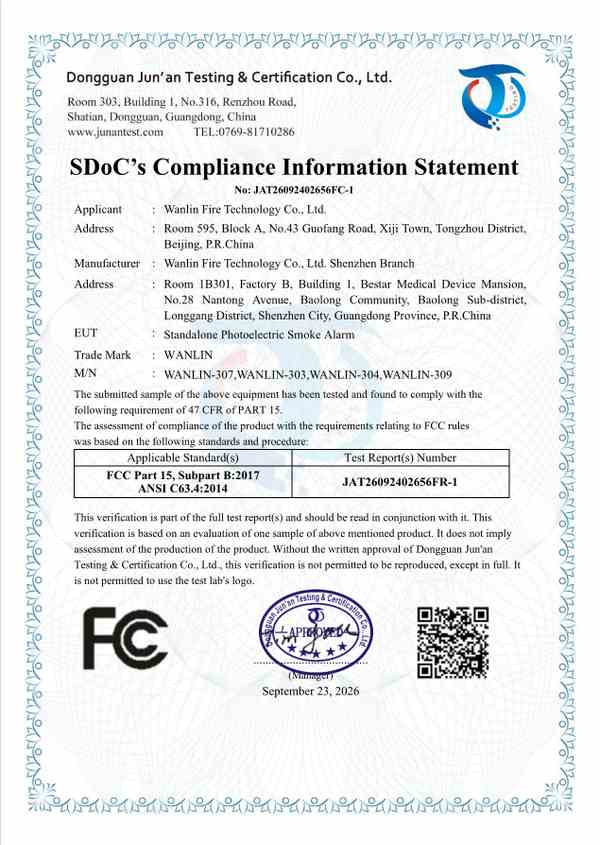
| Compliance statement | Supplier's Declaration of Conformity statement number JAT26092402656FC-1, dated 23 September 2026, listing models WANLIN-307, WANLIN-303, WANLIN-304 and WANLIN-309 under the trade mark WANLIN |
| Test report | Report number JAT26092402656FR-1, raised on a WANLIN-307 standalone photoelectric smoke alarm sample, tested from 11 to 19 September 2026 and issued 19 September 2026 |
| Standard applied | FCC 47 CFR Part 15 Subpart B, Class B, with the measurement procedure in ANSI C63.4:2014 |
| Verdict recorded | Conducted emission at the mains port PASS and radiated emission PASS, each recorded as complying with the limit in the standard |
| Laboratory | Dongguan Junan Testing and Certification Co Ltd, Room 303, Building 1, No.316, Renzhou Road, Shatian, Dongguan, Guangdong, China |
| Instrumentation | Rohde & Schwarz ESCI EMI test receiver, serial 101417, with L2-16B and ENV216 artificial mains networks, calibration due 1 September 2027 |
| Test configuration | Radiated emission measured at a 3 metre antenna distance with the antenna scanned from 1 to 4 metres in both vertical and horizontal polarisation, quasi-peak detector, 120 kHz bandwidth; conducted emission measured with a 200 Hz and 9 kHz bandwidth |
| Recorded conditions | Conducted emission at 24.3 degrees Celsius, 54.1 per cent relative humidity and 101.1 kPa; radiated emission at 24.0 degrees Celsius, 55.1 per cent relative humidity and 101.2 kPa |
| Supply on the tested sample | DC 3 V, one DC port, no AC port |
Three things in that table are worth reading twice. The first is the scope. Part 15 Subpart B is the electromagnetic emission side, which covers the product as an unintentional radiator. It is not an equipment authorisation for a radio transmitter. Where a configuration carries a cellular, narrowband, long range, mesh or short range radio, that transmitter needs its own authorisation for the destination market, and the bands have to match the operator plan. We separate the two on the paperwork because a buyer who discovers the difference at customs has a much worse problem than one who hears it in the quotation.
The second is the sample. The statement lists four models, but the test report behind it was raised on a WANLIN-307 sample. That is normal and it is not a defect, but it is the kind of detail that becomes a problem when it is presented as though it were not there. Where a buyer needs the paper for a different configuration, we say which document covers which unit rather than letting one stand in for the other.
The third is uncertainty, and it is the most useful thing in the report for a buyer who actually reads it. The laboratory states an expanded uncertainty of approximately +/-3.60 dB for conducted emission between 150 kHz and 30 MHz, +/-4.76 dB for radiated emission between 30 MHz and 1 GHz, and +/-4.44 dB between 1 GHz and 18 GHz, expressed at roughly the 95 per cent confidence level with a coverage factor of k = 2. The Class B limits at 3 metres are 40.00 dBuV/m from 30 to 88 MHz, 43.50 dBuV/m from 88 to 216 MHz, 46.00 dBuV/m from 216 to 960 MHz and 54.00 dBuV/m from 960 to 1000 MHz. A pass recorded against those limits is a statement about the sample on the day, in that chamber, with that instrumentation. The report says so itself: results relate to the tested sample, and other similar equipment will not necessarily produce the same results due to production tolerance and measurement uncertainties. That is why a margin in a report is evidence and not a promise, and why we quote it as evidence.
From Smoke Chamber to Sounder: How a Photoelectric Unit Decides
The sequence is short enough to state in full. Air reaches the sensing chamber, a light source and a sensor sit at an angle to each other so that clean air does not put light on the sensor, and smoke particles scatter light onto it. The unit compares what the sensor sees against the threshold, applies the response curve the standard sets rather than a single instantaneous reading, and drives the sounder when the condition is met. The rest of the design is what makes that decision trustworthy rather than merely possible.
Automatic self-test is the part that gets skipped on a cheap unit. A unit that never checks its own chamber is a unit whose first test is a fire, and the failure modes it misses are ordinary: dust on the chamber, an insect across the optical path, a cell that has sagged under load. Dust protection and insect protection on the chamber are what keep those from becoming permanent faults, which is why they are specified for industrial and plant positions rather than treated as an upgrade.
Fault, tamper and low cell are reported as separate conditions, and that separation is the design point most often lost. A unit that beeps the same way for three different problems trains the occupant to ignore it, and an ignored alarm is the same as no alarm. Where the configuration carries a relay output or a notification path, the same separation is what lets the platform tell you which of the three it is looking at.
Adjustable sensitivity exists on some configurations, and it is worth being blunt about what it is for. It is for matching the unit to the position, not for suppressing complaints. A unit whose sensitivity was dropped to stop a cooking nuisance is a unit that has been taken out of service without anyone writing that down, and false alarm reduction achieved that way is not false alarm reduction at all.
Power, Siting and Nuisance Alarm Planning for Japan Installations
Power is the first decision, and it follows the building rather than the catalogue. A sealed long life cell removes the battery change from the maintenance round, which is the single most common reason a working alarm stops working, and it is the usual specification for let property, holiday lets and stairwell positions where reaching the unit needs a ladder. A replaceable cell configuration suits a buyer who wants the unit serviced rather than replaced. A mains powered unit with battery backup suits a position where a circuit already exists and the occupant can be relied on to leave it alone.
Siting is the second decision and it is where nuisance alarms are actually won or lost. A photoelectric chamber mounted directly outside a kitchen or a bathroom will see steam and cooking aerosol as part of normal life, and no sensitivity setting will tell the difference reliably. The installation rule in force where the building stands sets the separation distances, and it is the rule we follow rather than the convenience of the cable route.
The record is the third decision, and it is the one that decides whether the scheme survives an inspection. A unit with no dated installation record has an unknown remaining service period, because the replacement cycle runs from the installation date and from nothing else. A unit fitted three years before a program started has three years less in it than the label suggests, and without a dated record nobody knows which units those are. Low battery warning, end of life warning and the test record are what turn a purchase into a program, and they are the three things an inspector asks for first.
Product Introduction: WANLIN-307 433MHz Wireless Smoke Alarm by Wanlin Fire
What follows is the product as configured, with the values that vary per model left to the datasheet rather than filled in.
Buyers rarely write to us using the catalogue name, and the phrase on the enquiry form usually tells us more about the market than about the product. The base configuration reaches us as WANLIN-307 smoke detector, WANLIN-307 standalone smoke alarm, WANLIN-307 standalone smoke detector, WANLIN-307 wireless smoke detector, WANLIN-307 wireless smoke alarm, WANLIN-307 photoelectric smoke detector, WANLIN-307 EN 14604 smoke alarm, WANLIN-307 CE certified smoke detector and WANLIN-307 RoHS smoke detector, and those are the enquiries where the certificate number has to be on the quotation rather than in a follow up. Radio configurations arrive as WANLIN-307 4G smoke alarm, WANLIN-307 NB-IoT smoke detector, WANLIN-307 LoRa smoke alarm, WANLIN-307 433MHz smoke detector, WANLIN-307 interconnected smoke alarm, WANLIN-307 interconnected smoke detector and WANLIN-307 wireless interconnected smoke alarm, and the band plan is settled before the radio is specified rather than after it. Power and service configurations arrive as WANLIN-307 battery smoke detector, WANLIN-307 battery smoke alarm, WANLIN-307 10-year battery smoke alarm, WANLIN-307 long-life battery smoke detector and WANLIN-307 low power smoke detector. Building type arrives as WANLIN-307 home smoke detector, WANLIN-307 home smoke alarm, WANLIN-307 residential smoke detector, WANLIN-307 residential smoke alarm, WANLIN-307 apartment smoke detector, WANLIN-307 hotel smoke detector, WANLIN-307 office smoke detector, WANLIN-307 commercial smoke detector and WANLIN-307 industrial smoke detector, which is the point where the room schedule decides the count rather than the carton. Capability shorthand arrives as WANLIN-307 smart smoke alarm, WANLIN-307 intelligent smoke detector, WANLIN-307 intelligent smoke alarm, WANLIN-307 IoT smoke alarm, WANLIN-307 self-test smoke alarm, WANLIN-307 fault monitoring smoke alarm, WANLIN-307 tamper proof smoke detector, WANLIN-307 cloud connected smoke detector, WANLIN-307 mobile app smoke alarm, WANLIN-307 push notification smoke alarm, WANLIN-307 SMS smoke alert, WANLIN-307 voice alert smoke alarm, WANLIN-307 strobe light smoke alarm and WANLIN-307 multi-sensor smoke detector, and each one is a configuration question rather than a different product. Commercial shorthand arrives as WANLIN-307 smoke detector wholesale, WANLIN-307 smoke alarm OEM, WANLIN-307 smoke detector price, WANLIN-307 smoke alarm MOQ, WANLIN-307 smoke detector sample and WANLIN-307 smoke alarm bulk order, and all six are answered in writing with the configuration and the certificate number on the same page.
Technical Specifications
| Parameter | Specification |
|---|---|
| System reference | WANLIN-307 |
| Product category | Standalone photoelectric smoke alarm that interconnects with other units in the same building over a short range radio link |
| Detection target | Smoke aerosol entering the sensing chamber at the mounting position |
| Sensing element | Photoelectric sensing chamber, with the chamber type and its stated service life given per model datasheet |
| Alarm logic | One unit in alarm causes every unit in the group to sound, so the warning is heard where the occupants are rather than only where the fire is |
| Protocol and integration | Short range radio interconnection on the configured variant, with the regional frequency and duty cycle set for the destination market |
| Notification path | Local audible alarm on every unit in the group, with a visual indicator on the housing |
| Alarm behaviour | The alarm condition holds until the chamber clears or the group is silenced, and the initiating unit can be identified at the housing |
| Power supply | Primary cell or sealed long life cell depending on the ordered configuration, with the report for the tested sample recording a DC 3 V supply, and exact ratings per model datasheet |
| Housing and mounting | Wall or ceiling mount housing for the room, with the position chosen for the chamber rather than for the signal |
| Installation pattern | One unit per storey and one per sleeping area, with the group tested as a whole after installation rather than unit by unit |
| Display and indication | Audible alarm and visual indicator on the housing, with a strobe, test button and silence button on the configured variant |
| Configuration and thresholds | Alarm response, confirmation windows, notification rules and escalation timing set at commissioning and recorded on the commissioning sheet |
| Maintenance and self test | Automatic self-check with fault, tamper, low battery and end of life conditions reported separately, with the test interval set by the site operator |
| FCC documentation support | Emission test report JAT26092402656FR-1, raised on a WANLIN-307 sample against FCC 47 CFR Part 15 Subpart B Class B with ANSI C63.4:2014, supplied with compliance statement JAT26092402656FC-1 and matched to the configuration on the order |
| Certification documents | CE, RoHS and REACH documentation per applicable model, with EN 14604 route papers where the device class applies and transmitter authorisation treated separately, certificate number provided on request |
| OEM and ODM options | Logo, part number, packaging, manual languages, label artwork and platform identity string configurable |
| Full datasheet | Complete electrical, radio, sensing and environmental data provided per model on request |
| Warranty | 36-month |
Application Scenarios for WANLIN-307 433MHz Wireless Smoke Alarm
| Scenario | Reference | Why it is specified here |
|---|---|---|
| House with bedrooms on two floors and no wiring between them | WANLIN-307 | Interconnection means the unit in the kitchen wakes the household rather than the room it is in |
| Small guest house where the owner does not live on site | WANLIN-307 | A group of units behaves like one system without a panel, a cabling run or a commissioning engineer |
| Refurbishment where chasing a cable would mean redecorating | WANLIN-307 | A radio group is fitted in an afternoon against a wired job that needs making good afterwards |
| Terraced house where the layout puts the kitchen next to the stairs | WANLIN-307 | The group is zoned so a cooking nuisance does not become a whole house evacuation |
The range covers standalone smoke detector and standalone smoke alarm configurations for home, residential, apartment, condo, townhouse, single-family and multi-family housing, for rental property, Airbnb and short-term rental, student housing and dormitory, senior living, assisted living and nursing home settings, and for hotel, motel, hostel, resort and bed and breakfast use. On the commercial and industrial side it covers office, corporate office, co-working space, retail store, supermarket, shopping mall, warehouse, factory, manufacturing plant, data center, server room, electrical room, boiler room, generator room, UPS room, battery room, parking garage, underground parking, tunnel, construction site and temporary building positions, together with RV, camper, caravan, boat, ship and marine applications on the configured variant. Room level specification covers kitchen, bedroom, living room, basement, garage, attic, laundry room, utility room, home office, nursery and baby room siting against the rule in force rather than against convenience.
Communication options on the configured variant cover 4G, 4G LTE, NB-IoT, LoRa, LoRaWAN, 433MHz, WiFi, Zigbee, Z-Wave, Bluetooth and RF wireless paths, with wireless mesh, wireless star network and wireless self-healing topologies, long range and through-wall performance planned per site. Functional options cover photoelectric and ionization sensing, dual sensor and multi-sensor units, multi-criteria detection, combination smoke and heat detector and combination smoke and CO detector configurations, battery operated, battery powered, hardwired and plug-in supply, 10 year sealed cell and long-life battery options, low battery warning, end of life warning, self-test and automatic self-check, fault monitoring, tamper proof and anti-tamper designs, dust protection and insect protection, IP65 and IP67 waterproof and dustproof housings, alarm memory, event history and data logging, remote diagnostics, OTA firmware update and remote configuration, cloud connected reporting, mobile app control, push notification, SMS and email alert, voice call, voice alert and multi-language voice alarm, and strobe light, sounder strobe and audible visual visual alarm device options.
Application shorthand is the same story, and it is worth reading as a list of positions rather than a list of products. Housing covers home smoke detector, residential smoke alarm, condo smoke detector, townhouse smoke alarm, single-family home smoke detector, multi-family home smoke alarm, vacation home smoke detector, rental property smoke alarm, Airbnb smoke detector and short-term rental smoke alarm work, where the landlord or the platform sets the requirement rather than the occupant. Managed and supported housing covers student housing smoke detector, dormitory smoke alarm, senior living smoke detector, elderly care smoke alarm, assisted living smoke detector, nursing home smoke alarm, memory care smoke detector, independent living smoke alarm and retirement community smoke detector programs, where the record matters as much as the unit because somebody has to prove the round happened. Dwelling types cover mobile home smoke alarm, tiny house smoke detector, cabin smoke alarm, log home smoke detector, villa smoke alarm, mansion smoke detector and luxury home smoke alarm specifications, and the connected end covers smart home smoke detector, automated home smoke alarm, connected home smoke detector and home security smoke alarm integration.
Room level shorthand covers kitchen smoke detector, bedroom smoke alarm, living room smoke detector, basement smoke alarm, garage smoke detector, attic smoke alarm, laundry room smoke detector, utility room smoke alarm, home office smoke detector, nursery smoke alarm, baby room smoke detector, children safety smoke alarm and pet friendly smoke detector siting, and the separation distances are set by the rule in force rather than by where the cable would have run. Hospitality covers hotel smoke detector, motel smoke alarm, hostel smoke detector, resort smoke alarm, bed and breakfast smoke detector, restaurant smoke alarm, cafe smoke detector, bar smoke alarm and nightclub smoke detector work, where the unit is visible during the room round rather than hidden behind a fitting. Commercial covers corporate office smoke detector, co-working space smoke alarm, retail store smoke detector, supermarket smoke alarm, shopping mall smoke detector, convenience store smoke alarm and department store smoke detector programs. Industrial covers factory smoke detector, manufacturing plant smoke detector, data center smoke alarm, server room smoke detector, electrical room smoke alarm, boiler room smoke detector, HVAC smoke alarm, generator room smoke detector, UPS room smoke alarm and battery room smoke detector positions, where the environment rather than the building decides the housing. Infrastructure covers parking garage smoke alarm, underground parking smoke detector, tunnel smoke alarm, construction site smoke detector, temporary building smoke alarm and portable building smoke detector work, and the mobile and marine end covers RV smoke alarm, camper smoke detector, caravan smoke alarm, boat smoke detector, ship smoke alarm, marine smoke detector, offshore platform smoke alarm, oil rig smoke detector and mining smoke alarm specifications on the configured variant.
Radio shorthand works the same way, and it is where the most expensive misunderstandings start, because two buyers can use the same three words for two different configurations. Cellular covers 4G smoke alarm, 4G standalone smoke detector, 4G wireless smoke detector, 4G LTE smoke alarm, 4G cellular smoke detector, 4G connected smoke alarm, 4G IoT smoke detector and 4G smart smoke alarm enquiries, where the operator, the band plan and the data arrangement are settled on the order rather than discovered in the field. Narrowband covers NB-IoT smoke detector, NB-IoT standalone smoke detector, NB-IoT wireless smoke detector, NB-IoT smart smoke alarm, NB-IoT IoT smoke detector, NB-IoT connected smoke alarm and NB-IoT cellular smoke detector programs, where the operator footprint is checked estate by estate rather than read off a coverage map. Long range covers LoRa smoke alarm, LoRa standalone smoke detector, LoRa wireless smoke detector, LoRaWAN smoke alarm, LoRaWAN standalone smoke detector, LoRaWAN wireless smoke alarm, LoRa long range smoke detector, LoRa IoT smoke detector and LoRa connected smoke alarm work, where long range is specified for the link budget and not for the headline distance on the box. Short range covers 433MHz smoke detector, 433MHz standalone smoke detector, 433MHz wireless smoke detector and 433MHz RF smoke detector groups, together with WiFi standalone smoke detector, WiFi wireless smoke alarm, Zigbee smoke detector, Z-Wave smoke detector, Z-Wave smoke alarm, Bluetooth smoke detector, Bluetooth smoke alarm and RF wireless smoke alarm configurations. Topology covers wireless mesh smoke detector, wireless star network smoke alarm, wireless self-healing smoke detector, long range wireless smoke detector, through-wall wireless smoke detector and low power wireless smoke detector planning, and the regional frequency plan is set on the order because a unit for the wrong region cannot be quietly reprogrammed.
Wireless functional shorthand covers battery powered wireless smoke detector, 10-year battery wireless smoke alarm, replaceable battery wireless smoke detector, sealed battery wireless smoke alarm, low battery warning wireless smoke alarm, fault monitoring wireless smoke alarm, self-diagnostic wireless smoke detector, automatic self-test wireless smoke alarm, remote diagnostics wireless smoke alarm, OTA firmware update wireless smoke alarm, remote configuration wireless smoke alarm, data logging wireless smoke alarm, event history wireless smoke alarm, alarm memory wireless smoke alarm and real-time wireless smoke monitoring, which is the group that decides whether a fleet is managed or merely installed. Notification shorthand covers cloud connected wireless smoke detector, mobile app wireless smoke alarm, push notification wireless smoke alarm, SMS wireless smoke alert, email wireless smoke alert, voice call wireless smoke alarm, voice evacuation wireless smoke alarm, strobe light wireless smoke alarm, sounder strobe wireless smoke alarm, audible visual wireless smoke alarm and visual alarm device wireless smoke detector options, and in every one of them the local audible alarm stays the safety function while the network carries the record.
Sensing and supply shorthand follows the same pattern. Chamber type covers ionization smoke detector, ionization smoke alarm, dual sensor smoke detector, dual sensor smoke alarm, multi-sensor smoke detector, multi-sensor smoke alarm, multi-criteria smoke detector, smoke and heat detector combo and smoke and CO detector combo enquiries, and the honest answer is that the standard named for the destination market decides which one is built rather than our own preference. Independence covers independent smoke detector and independent smoke alarm specifications, which is the plainest way of saying that the unit does not depend on a panel, a network or a neighbour. Supply covers battery operated smoke detector, battery operated smoke alarm, battery powered smoke detector, battery powered smoke alarm, hardwired smoke detector, hardwired smoke alarm, plug-in smoke detector and plug-in smoke alarm configurations, and service period covers 10-year battery smoke detector, 10-year battery smoke alarm, long-life battery smoke detector, long-life battery smoke alarm, sealed battery smoke detector, sealed battery smoke alarm, replaceable battery smoke detector and replaceable battery smoke alarm options. Condition reporting covers low battery indicator smoke detector, low battery warning smoke alarm, end of life warning smoke detector, self-test smoke detector, self-test smoke alarm, automatic self-check smoke detector, fault monitoring smoke alarm, tamper proof smoke detector and anti-tamper smoke alarm designs. Environmental covers dust protection smoke detector, insect protection smoke detector, wide temperature smoke detector, high humidity smoke detector, IP65 smoke detector, IP67 smoke detector, waterproof smoke detector and dustproof smoke detector housings, and behaviour covers adjustable sensitivity smoke detector, false alarm reduction smoke detector and nuisance alarm prevention smoke detector settings. Record keeping covers alarm memory smoke detector, event history smoke detector, data logging smoke detector, remote diagnostics smoke detector, OTA firmware update smoke detector and remote configuration smoke detector functions, which are the six that decide whether the second year of a program is manageable.
Market Access Paperwork: SDoC, the US Responsible Party and National Registration
Paperwork is where most first shipments fail, and it fails in the same place every time: somebody assumed a document covered more than it did. The FCC route is the clearest example, because it has a specific obligation that sits with the importer rather than with the factory, and it is almost never mentioned until it is a problem.
A Supplier's Declaration of Conformity is not the same thing as an FCC equipment authorisation with an FCC ID. Under the SDoC route the compliance information statement has to accompany the product at the time of marketing or importation, giving the product identification, the compliance statement, and the identification by name, address and contact detail of the responsible party. The responsible party for a Supplier's Declaration of Conformity must be located within the United States. That is the importer side of the line, not ours, and it is worth planning before the container ships rather than after it lands.
Labeling follows the same route. A device subject to certification or to a Supplier's Declaration of Conformity has to carry the Part 15.19 statement in a conspicuous location on the device, and devices under the SDoC route may carry the FCC logo on a voluntary basis as a visual indication of compliance. The user manual has to carry the Part 15.21 caution, which is the one that tells the user that changes or modifications not expressly approved by the party responsible for compliance could void the authority to operate the equipment. We supply the wording and the artwork; we do not certify compliance and we do not sign the importer side of the record.
- Technical file prepared to support national registration by the importer of record, which is the part most often missing at the border.
- CE, RoHS and REACH documentation per applicable model, with certificate numbers provided so they can be checked with the issuing body.
- Test report and compliance statement matched to the exact configuration on the order, not borrowed from a similar model.
- FCC Part 15 Subpart B emission evidence on the tested sample, with the test report number and the statement number given on request.
Beyond the FCC route, the reference basis for European supply is EN 14604 for smoke alarms, with EN 54-7 for smoke detectors used in fire detection and fire alarm systems, EN 54-25 for radio linked components, EN 54-5 for heat detectors, EN 54-11 for manual call points, EN 54-3 for sounders and EN 54-23 for visual alarm devices, together with the Construction Products Regulation route under EU 305/2011 and the declaration of performance that goes with it. North American buyers generally ask for UL 217 for smoke detectors and UL 268 where it applies, with UL 2034 for carbon monoxide alarms and UL 864 for control equipment, while NFPA 72 is the installation, testing and maintenance rule those schemes are written against and BS 5839 plays the same part in British specifications. UKCA covers Great Britain, CSA and ETL cover Canadian and North American listings, and VdS, LPCB and FM approvals come up in specifications that follow a European insurance route. EAC and GOST cover the Eurasian route, CCCF and BIS cover Chinese and Indian domestic registration, TISI, SNI, SIRIM, PS Mark and DTI-BPS cover South East Asian national schemes, SASO and SABER cover Saudi Arabia, and Civil Defense approval, BFP approval and SBC 801 alignment appear in Middle Eastern specifications. Where a scheme asks for a type approved or third-party certified unit we supply the laboratory tested evidence and the certificate of conformity we hold rather than a description of one, and where a buyer needs NIST traceable calibration on the test instrumentation we say which instruments carried it. RoHS 2.0 and REACH SVHC declarations are issued per applicable model, the test report is identified by its number, and the declaration of performance is prepared for the CPR route. The factory operates to ISO 9001 and ISO 14001, and the certificates are provided on request. We prepare the technical file to support whichever of those the importer of record needs, and we give the certificate number so it can be checked with the issuing body rather than taken from a quotation.
Where a specification uses shorthand, this is what that shorthand means when it reaches our quotation, and it is worth matching the phrase to the document before the order is placed rather than after the container ships.
- EN 14604 smoke alarm - the European reference, requested as an EN 14604 certified smoke detector and supplied as an EN 14604 compliant smoke alarm with the route papers identified by number.
- EN 54-7 smoke detector - the system device reference, with EN 54-25 wireless smoke alarm for radio linked components and EN 54-5 heat detector where the position calls for it.
- EN 54-11 manual call point - the manual trigger reference, with EN 54-3 sounder and EN 54-23 visual alarm device references for the alerting side of the same scheme.
- CPR compliant smoke detector - the Construction Products Regulation smoke alarm route under EU 305/2011 smoke detector rules, which is what the declaration is written against.
- declaration of performance smoke alarm - the document the CPR route asks for, supported by the certificate of conformity smoke detector file and the test report smoke alarm carried by its number.
- CE certified smoke detector - marking for the applicable model, with the CE marked smoke alarm label and the CE declaration smoke detector file both matched to the unit on the order.
- RoHS compliant smoke detector - issued as RoHS 2.0 smoke detector declarations, with REACH compliant smoke alarm and REACH SVHC smoke alarm statements issued per applicable model.
- FCC certified smoke detector - used loosely in the trade for the emission route, and supported here by laboratory tested smoke detector evidence with NIST traceable calibration smoke detector instrumentation named on the record.
- UL 217 smoke detector - the North American smoke detector reference, requested as a UL 217 certified smoke alarm, with UL 268 smoke detector and UL 268 certified smoke alarm where the specification names them.
- UL 2034 CO alarm - the carbon monoxide reference for combination units, with UL 864 fire alarm panel for control equipment and NFPA 72 compliant smoke detector installation referenced as NFPA 72 smoke alarm work in practice.
- BS 5839 smoke detector - the British specification route, quoted as a BS 5839 smoke alarm scheme, with UKCA marked smoke detector covering Great Britain.
- ETL listed smoke detector - the North American listing route, with CSA certified smoke alarm for Canada and FM approved smoke detector where an insurance led specification asks for it.
- VdS approved smoke detector - the German insurance route, with LPCB approved smoke alarm for the British equivalent and ISO 7240 smoke detector referenced for the system parts.
- ISO 9001 smoke detector manufacturer - the quality system we run to, with ISO 14001 smoke alarm manufacturer for the environmental system and third-party certified smoke alarm evidence supplied where a scheme asks for it.
- EAC certified smoke detector - the Eurasian route, with GOST certified smoke alarm alongside it and CCCF certified smoke detector for Chinese domestic registration.
- BIS certified smoke detector - Indian registration, with TISI certified smoke detector for Thailand and SNI certified smoke alarm for Indonesia.
- SIRIM certified smoke detector - the Malaysian route, with PS Mark smoke alarm for the Philippines and DTI-BPS certified smoke detector alongside it.
- SASO certified smoke detector - Saudi Arabia, released through SABER certified smoke alarm, with Civil Defense approved smoke detector where the authority asks for it directly.
- BFP approved smoke alarm - the Philippine fire service route, with SBC 801 compliant smoke detector for Gulf specifications and type approved smoke detector wording where a scheme uses it.
Why Choose Wanlin Fire as Your Standalone Smoke Alarm Manufacturer for Japan
The argument for working with us is not a slogan. It is that the paperwork, the configuration and the delivered unit are the same thing. The comparison that follows is the one buyers actually run, which is not a datasheet comparison.
| Buying factor | Wanlin Fire | Trading office | Local brand |
|---|---|---|---|
| Minimum and samples | Minimum set by their stock, not by yours | Minimum rarely negotiable | |
| OEM and ODM scope | Limited to what the factory allows them | Not offered at all | |
| Branding and packaging | Repackaging only | Their brand or nothing | |
| Documentation and manuals | Passed on unread | Local language only | |
| Traceability | Report and statement matched to the configuration on the order | Whichever certificate is in the folder | Strong, and priced accordingly |
- Warranty terms stated per configuration in writing, with the claim route named on the same page.
- Samples built on the production configuration, so what was approved is what is delivered.
- A named contact for the program rather than a mailbox that changes hands between shipments.
- Spare parts and accessories quoted with the order, so the second year does not start with a search.
Our export programs suit smoke detector distributors and wholesalers, importers, sourcing agents, building materials dealers, electrical wholesalers, security systems integrators, smart home brand owners, hospitality procurement teams, property management buyers, construction materials traders, tender contractors and warehouse operators. Whether you need a smoke alarm with EN 14604, a smoke detector with UL 217, a unit with CE, RoHS, FCC, UKCA, EAC, SASO or SABER documentation, we supply the file and the certificate number rather than a claim. We supply smoke detector for Europe, smoke alarm for USA, smoke detector for Middle East, smoke alarm for Southeast Asia, smoke detector for Africa, smoke alarm for South America, smoke detector for Australia, smoke alarm for Canada, smoke detector for UK, smoke alarm for Germany, smoke detector for France, smoke alarm for Italy, smoke detector for Spain, smoke alarm for Netherlands, smoke detector for Poland, smoke alarm for Saudi Arabia, smoke detector for UAE, smoke alarm for Thailand, smoke detector for Vietnam, smoke alarm for Indonesia, smoke detector for India, smoke alarm for Brazil and smoke detector for Mexico programs, and the market decides which route the file is prepared for rather than the factory. Smoke detector customization and smoke alarm certification support are written into the program scope rather than offered later as chargeable extras, which is the difference between a quotation a buyer can approve and one that keeps growing.
If you are searching for an X-Sense smoke detector alternative, a Kidde smoke alarm alternative, a First Alert smoke detector alternative, a BRK smoke alarm alternative, a Nest smoke detector alternative, a Google Nest Protect alternative, a Ring smoke alarm alternative, a Honeywell smoke detector alternative, a Hochiki smoke alarm alternative, an Apollo smoke detector alternative, a System Sensor smoke alarm alternative, an Edwards smoke detector alternative, a Gent smoke alarm alternative, a Morley smoke detector alternative, a Notifier smoke alarm alternative, an Esser smoke detector alternative, a Siemens smoke alarm alternative, a Bosch smoke detector alternative, a Panasonic smoke alarm alternative, a Nittan smoke detector alternative, a Fike smoke alarm alternative or a China smoke detector alternative, an affordable smoke detector, a cost-effective smoke alarm, a high-quality low-price smoke detector, a smoke detector made in China, a Chinese smoke alarm competitor, a Chinese smoke detector quality comparison or a smoke detector price comparison China vs Europe, the comparison that actually decides it is the certificate number, the stated service period and the documents that arrive with the shipment, and those are the three we put in writing before you order. The same applies to WANLIN smoke detector alternative searches: the useful question is not who we are like, it is what we can prove.
Programs we run cover the USA smoke detector market, the Canada smoke alarm market, the UK smoke detector market, the Germany smoke alarm market, the France smoke detector market, the Italy smoke alarm market, the Spain smoke detector market, the Netherlands smoke alarm market, the Poland smoke detector market, the Belgium smoke alarm market, the Sweden smoke detector market, the Austria smoke alarm market, the Switzerland smoke detector market, the Ireland smoke alarm market, the Norway smoke detector market, the Denmark smoke alarm market, the Finland smoke detector market, the Portugal smoke alarm market, the Greece smoke detector market, the Czech Republic smoke alarm market, the Hungary smoke detector market, the Romania smoke alarm market, the Bulgaria smoke detector market, the Croatia smoke alarm market, the Slovakia smoke detector market, the Slovenia smoke alarm market, the Estonia smoke detector market, the Latvia smoke alarm market, the Lithuania smoke detector market, the UAE smoke detector market, the Saudi Arabia smoke alarm market, the Qatar smoke detector market, the Kuwait smoke alarm market, the Oman smoke detector market, the Bahrain smoke alarm market, the Singapore smoke detector market, the Malaysia smoke alarm market, the Indonesia smoke detector market, the Thailand smoke alarm market, the Vietnam smoke detector market, the Philippines smoke alarm market, the India smoke detector market, the Japan smoke alarm market, the South Korea smoke detector market, the Australia smoke alarm market, the New Zealand smoke detector market, the Brazil smoke alarm market, the Mexico smoke detector market, the South Africa smoke alarm market and the Nigeria smoke detector market, and what changes between them is the registration route, the radio band plan and the language on the label rather than the hardware.
Trade shorthand is the last group, and it is the one that decides whether a quotation can actually be approved. Sourcing covers smoke detector factory, smoke detector ODM, custom smoke detector, branded smoke alarm, China smoke detector manufacturer, smoke detector factory China and smoke detector factory direct enquiries, and the answer to all seven is the same evidence: the certificate number, the stated service period and the documents that arrive with the shipment. Volume covers smoke detector wholesale, smoke alarm bulk supplier, smoke detector exporter, smoke alarm export, smoke alarm MOQ, smoke detector sample order, smoke alarm bulk order, smoke detector inventory, smoke alarm stock, smoke detector ready to ship, smoke alarm fast delivery, smoke detector lead time and smoke alarm production capacity questions, and each one is answered per configuration rather than for a range. Movement covers smoke detector shipping, smoke detector FOB, smoke alarm CIF, smoke detector EXW, smoke alarm importer, smoke detector trading company, smoke alarm procurement, smoke detector sourcing and smoke alarm supply chain arrangements, and the incoterm is written on the quotation rather than agreed over a messaging app. Documentation covers smoke detector certification support, smoke alarm technical documentation, smoke detector user manual, smoke alarm installation guide, smoke detector warranty and smoke alarm after-sales questions, together with smoke detector spare parts and smoke alarm accessories quoted with the order. Finish covers smoke alarm packaging, smoke detector labeling and smoke alarm branding under change control. Approval shorthand covers smoke detector with CE, smoke alarm with RoHS, smoke detector with FCC, smoke alarm with UKCA, smoke detector with EAC, smoke alarm with SASO and smoke detector with SABER requests. Destination shorthand covers smoke alarm for Europe, smoke detector for USA, smoke alarm for Middle East, smoke detector for Southeast Asia, smoke alarm for Africa, smoke detector for South America, smoke alarm for Australia, smoke detector for Canada, smoke alarm for UK, smoke detector for Germany, smoke alarm for France, smoke detector for Italy, smoke alarm for Spain, smoke detector for Netherlands, smoke alarm for Poland, smoke detector for Saudi Arabia, smoke alarm for UAE, smoke detector for Thailand, smoke alarm for Vietnam, smoke detector for Indonesia, smoke alarm for India, smoke detector for Brazil and smoke alarm for Mexico programs, and in every one the market decides which route the file is prepared for rather than the factory.
Standalone Smoke Alarm OEM, ODM and Program Delivery from China to Japan
This is the sequence we work to, with the decisions that need the buyer at each stage marked as decisions rather than as formalities. We supply local code submittal support with per-configuration technical files, radio compliance evidence, emission test report and compliance statement matched to the ordered configuration, and national registration support for the importer of record. A standard order then follows 8 steps:
- Tell Us Your Target Market - the country, the smoke alarm standard and installation rule in force, the radio and data rules, the registration scheme and the labeling language; each market runs different certification routes, radio band plans, language sets and audit expectations
- Send the Room Schedule - the building or dwelling list, the storeys, the sleeping areas, the kitchens and bathrooms that constrain siting, the mounting constraints, the compartment drawing and who is expected to respond
- Receive the Specification - the unit and configuration list, the mounting positions, the interconnection arrangement where it applies and the commissioning procedure, all stated in writing before any commercial discussion
- Verify Documentation - request the CE, RoHS and REACH files, the EN 14604 route papers where they apply, the emission test report and compliance statement with their numbers, the transmitter authorisation for the destination market, then check the issuing body reference yourself
- Confirm OEM Requirements - housings, logo, part numbers, languages, packaging, manuals, label artwork, the installation guide wording and the record templates your service uses
- Sample Evaluation - a sample kit covering the configurations you intend to sell can be field tested by your own team in your own market before commercial terms are agreed according to the agreed conditions
- Confirm Production - after specifications, commercial terms and OEM details are confirmed, the project moves into a production slot with a confirmed date, and the lead time and production capacity are stated per configuration
- Shipment - goods are prepared for shipment FOB, CIF or EXW according to the agreed logistics requirements, with packing built for long sea legs and inventory held for repeat partner programs
Customer Testimonials
What follows is from distributors and operators running the same configuration, given with permission to name the role but not the company.
- Anna Kowalski (Fire Safety Distributor, Kuwait City, Kuwait): "What I value is that they named what they do not sign. It makes the rest of the paperwork easier to believe. (Kuwait City, Kuwait)"
- Maria Santos (Warehouse Operations Manager, Doha, Qatar): "We had been buying on unit price for four years and had never once asked which sample the report was raised on. That question changed who we buy from. (Doha, Qatar)"
- Johan Bergstrom (Online Marketplace Seller, Osaka, Japan): "Our first shipment cleared because the technical file supported our name as importer of record. The previous supplier had never mentioned that was our job. (Osaka, Japan)"
Frequently Asked Questions
Q: How many units can be in one group?
A: It is stated per model datasheet rather than assumed, and it varies with the regional configuration. What matters more in practice is that the group is tested as a whole after installation, because a unit that was never paired is a unit that will stay silent when it matters.
Q: Will it interfere with other devices in the building?
A: The band is licensed exempt in most markets rather than exclusive, so the honest answer is that it shares the band. What keeps it workable is the regional frequency plan and the duty cycle, which is why the configuration is set for the destination market rather than shipped as a default.
Q: Can the group be extended later?
A: Yes, and that is usually how these schemes actually grow. The part that needs planning is the record: the group has to be re tested after the extension, not just after the first install, and the pairing procedure has to be written down for whoever does the second visit.
Q: Is interconnection covered by the FCC statement?
A: No. JAT26092402656FC-1 addresses Part 15 Subpart B for the tested sample, which is the emission side. The intentional radiator in an interconnected unit carries its own approval requirement for the destination market, and the two are documented separately because they answer different questions.
Q: Which unit started the alarm?
A: On the configured variant the initiating unit is identified at the housing, which is the difference between an evacuation and a search. It is also the feature most often skipped on a cheap unit, and the one a building manager misses first when it is not there.
Project Summary
What changed: By working directly with manufacturer Wanlin Fire, Osaka Online Marketplace Seller Johan Bergstrom gained 38% margin headroom while keeping competitive installed pricing. With verified per-model documentation, a written room schedule and installation record, smoke alarm construction to EN 14604 for the European route and to the standard named for the destination market elsewhere, with FCC Part 15 Subpart B emission evidence on the tested sample, the interconnection radio approved for the regional band in use, and certificate numbers provided on request, fault, tamper and low battery reporting with a supervision option on the configured variant, private label branding, a trial on their own buildings before the order and after-sales spare programs, Wanlin Fire became their long-term standalone smoke alarm supply partner in Japan. We are a source factory actively recruiting local partners, and cross border trading companies are welcome to start with a sample order and grow into bulk order programs.
For more information: www.wanlinfire.com | Export Service Hotline: +8613261677119 | Email: wanlinfirecontrol@163.com
- Shenzhen HQ: Wanlin Group, Room 1B301, Factory B, Building 1, Bestar Medical Device Mansion, No.28 Nantong Avenue, Baolong Community, Baolong Sub-district, Longgang District, Shenzhen, Guangdong, China